
Medically reviewed by Dr. Samuel Davidoff, MD, Board-Certified Gastroenterologist | 18+ Years Experience | Last Updated: May 2026
Quick Answer
Most patients can avoid nausea during colonoscopy prep by combining six tactics: chill the prep solution, sip 8 oz through a straw every 15 minutes, take an antiemetic like ondansetron (Zofran) one hour before the first dose, switch to a split-dose schedule, eat low-fiber meals for 2 to 3 days before, and pause 30 to 60 minutes if you start to vomit. Nausea is the most common prep side effect, but it is manageable. If you cannot keep prep down for 2 hours, call our Forest Hills office at (718) 261-0900.
Why Does Colonoscopy Prep Make You Nauseous?
Colonoscopy prep solutions, such as polyethylene glycol (PEG) and sulfate-based laxatives, work by pulling a large amount of fluid into the bowel in a short window. Three things stimulate the nausea pathway at once:
- Volume: Drinking 16 to 64 ounces of liquid in 1 to 2 hours stretches the stomach.
- Taste: The salty or chemically sweet flavor triggers a gag response after the first few cups.
- Cramping: The bowel begins contracting almost immediately, which sends nausea signals back to the brain.
Anxiety about the procedure and dehydration earlier in the day amplify all three. Understanding the mechanism is the first step in disarming it.
Is It Normal to Feel Nauseous During Colonoscopy Prep?
Yes. Nausea is the most commonly reported side effect of bowel prep, affecting roughly half of patients to some degree. Mild queasiness is expected and does not mean the prep is failing. The goals are to manage the discomfort, keep enough of the prep down to clear your colon, and recognize when nausea has crossed into a problem that needs a phone call.
Stop and call our office at (718) 261-0900 if you are vomiting more than three times, cannot keep any prep or fluid down for 2 hours, see blood in your vomit, or have severe abdominal pain that is not just cramping.
8 Ways to Prevent Nausea Before You Start Prep
1. Ask Your Gastroenterologist About a Split-Dose Schedule
Split-dose prep, drinking half the solution the evening before and the second half 4 to 6 hours before the procedure, is the single most effective change for nausea reduction. Each dose is half the volume, so each round is easier to tolerate. Modern guidelines also show split-dose produces a cleaner colon than single-dose. Request it if your prep instructions default to single-dose.
2. Request an Antiemetic Like Ondansetron (Zofran)
Ondansetron, sold as Zofran, is the most common prescription antiemetic for prep nausea. The standard schedule is 4 mg taken 1 hour before the first laxative dose, then every 6 to 8 hours during the prep period. Over the counter, dimenhydrinate (Dramamine) can also blunt nausea. Ask Dr. Davidoff to add an antiemetic to your prep instructions, especially if you have failed prep due to vomiting before.
3. Chill the Prep Solution in the Fridge
Cold prep tastes noticeably less salty and triggers less of a gag reflex. Refrigerate the mixed solution for at least 2 hours before drinking. Some patients add a few ice cubes between sips. Do not freeze it.
4. Drink Through a Straw, Past Your Taste Buds
A straw delivers the prep behind most of the taste buds on the tongue. Combined with cold prep, this is the highest-leverage taste hack. A reusable insulated tumbler with a straw works well because it keeps the solution cold from the first sip to the last.
5. Sip 8 Ounces Every 15 Minutes, Not All at Once
Drinking the dose in one sustained chug overwhelms the stomach and almost guarantees vomiting. Pace each 8 oz cup over 15 minutes. Set a timer. Most preps are designed to be finished in roughly 1 hour per dose, which is 4 cups at this pace.
6. Eat Low-Fiber, Smaller Meals 2 to 3 Days Before
Starting your low-residue diet 2 to 3 days before the procedure, instead of just the day before, leaves less stool in the colon for the prep to push out. Less material means less cramping and less nausea. Stick to white rice, eggs, baked chicken or fish, low-fiber white bread, and broth.
7. Pre-Hydrate With Electrolyte Drinks Like Pedialyte
Drink 64 to 80 ounces of clear fluids the day before prep starts. Hydration before the prep softens the impact of the osmotic load. Pedialyte, Gatorade (light colors only), or coconut water replace the sodium and potassium you will lose during prep, which itself reduces nausea.
8. Avoid Red, Purple, and Blue Dyes in Clear Liquids
Red, purple, and blue dyes can stain the colon and look like blood during the procedure, sometimes forcing a repeat. They also tend to make nausea worse. Choose clear, light yellow, or light green fluids: water, apple juice, white grape juice, lemon Italian ice, light Gatorade. For a full list of other prep restrictions, including gum and hard candy guidance, see our companion guide.
Knowing Your Prep Type Affects How Nauseous You Feel
Insurance coverage and your medical history determine which prep your gastroenterologist prescribes. Volumes vary widely, and so does the nausea profile.
- MiraLAX + Gatorade (PEG 3350): 64 oz total. Largest volume, mildest taste, often best tolerated.
- GoLYTELY / NuLYTELY: 4 liters of PEG-electrolyte solution. High volume, salty taste, higher nausea rate.
- Suprep: Two 6 oz doses diluted in water (32 oz total liquid per dose). Low volume, very salty taste.
- Plenvu: Two doses of about 16 oz each. Lower volume than GoLYTELY, mango or fruit punch flavor, well tolerated.
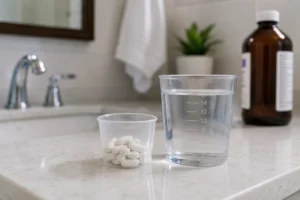
- Sutab: 24 oral tablets taken in two rounds with 16 oz of water each. No prep liquid to swallow, often best for patients who fail liquid preps due to vomiting.
If you have failed prep before due to nausea or vomiting, ask our office at least one week before your procedure. We can request a switch to a low-volume option like Suprep, Plenvu, or Sutab tablets, or move you to a split-dose schedule. Detailed endoscopy prep instructions are available for each prep type.
What to Do if You Vomit During Colonoscopy Prep
Pause for 30 to 60 Minutes
Stop drinking immediately. Sit upright, breathe slowly, and let your stomach settle for 30 to 60 minutes. Most patients can resume after a short break.
Take an Anti-Nausea Medication
If you have ondansetron (Zofran), Dramamine, or another antiemetic on hand, take it now. The medication needs about 30 minutes to start working, which lines up with the pause.
Resume Slowly With Smaller Sips
Restart with 2 to 4 oz sips every 15 minutes for the first 30 minutes, then return to the regular pace. Do not skip the rest of the dose. An incomplete prep usually means a repeat colonoscopy.
When to Call Our Office vs. Go to the ER
Call our Forest Hills office at (718) 261-0900 if you have vomited more than three times, cannot keep any prep or fluid down for 2 hours, or are anxious about completing the prep on time.
Go to the emergency room if you vomit blood, have severe abdominal pain that does not feel like cramping, are dizzy or confused, or pass blood that is not on the toilet paper.
If you are pregnant and concerned about whether colonoscopy or its prep is safe for you, see our guide to alternative diagnostic options for pregnant patients.
Relaxation and Distraction Tactics That Help
Anxiety amplifies nausea. Slow box breathing (inhale 4 seconds, hold 4, exhale 4, hold 4) for 2 minutes between cups can settle both. Set up a comfort kit before you start: a long show or movie, a podcast, a phone charger near the bathroom, a soft pair of stretchy pants, flushable wipes, and a barrier cream like Calmoseptine. Keeping your mind anchored to something other than the prep makes the time pass faster.
Aftercare Tips to Support Recovery
- Ease back into eating. Start with broth, white rice, scrambled eggs, or toast. Avoid raw vegetables, nuts, and heavy meats for 24 hours.
- Keep hydrating. Continue 64 to 80 oz of clear fluids in the 24 hours after the procedure.
- Replenish electrolytes. Pedialyte, coconut water, or a light sports drink replaces sodium and potassium lost during prep.
- Rest for 24 hours. Sedation effects linger. Do not drive, operate machinery, sign legal documents, or make important decisions for the rest of the day.
- Expect mild bloating or gas. Walking gently helps. Severe abdominal pain or rectal bleeding warrants a call to our office.
If your colonoscopy is approaching, you can schedule a colonoscopy at our Forest Hills office.
Visit Gastroenterology & Nutrition P.C. in Forest Hills, Queens
If colonoscopy prep nausea has caused you to fail prep before, or you are anxious about getting through the bowel-clearing phase, our team can help. Dr. Samuel Davidoff and the gastroenterology team at Gastroenterology & Nutrition P.C. can pre-screen your prep tolerance, prescribe an antiemetic in advance, and walk you through what to expect.
Gastroenterology & Nutrition P.C. has cared for Queens patients for over 20 years from our Forest Hills office, with same-week scheduling, Sunday hours, and Spanish-speaking staff at the front desk.
Address: 108-16 72nd Avenue, 2nd Floor, Forest Hills, NY 11375
Phone: (718) 261-0900
Hours: Sunday 9 AM to 1 PM, Monday/Wednesday/Thursday 9 AM to 5 PM, Tuesday/Friday 9 AM to 4 PM
Neighborhoods we serve: Forest Hills, Rego Park, Kew Gardens, Elmhurst, Jackson Heights, Middle Village, Ridgewood, Astoria, Flushing, Richmond Hill, Glendale, and surrounding Queens communities.
Frequently Asked Questions
Why does colonoscopy prep make you nauseous?
The high volume of polyethylene glycol (PEG) or sulfate-based solution pulls a large amount of fluid into the bowel quickly. The combination of salty taste, large volume in a short window, and bowel cramping triggered by the laxative all stimulate the nausea pathway. Anxiety and dehydration make it worse.
Is it normal to feel nauseous during colonoscopy prep?
Yes. Nausea is one of the most commonly reported side effects of bowel prep, affecting roughly half of patients. Most can manage it with sipping techniques, chilling the solution, and an antiemetic. If you cannot keep prep down for 2 hours, call your gastroenterologist.
What anti-nausea medication is best for colonoscopy prep?
Ondansetron (Zofran) is the most commonly prescribed antiemetic for prep nausea, typically 4 mg taken 1 hour before the first laxative dose and then every 6 to 8 hours during the prep period. Over the counter, dimenhydrinate (Dramamine) can also help.
What should I do if colonoscopy prep makes me vomit?
Pause for 30 to 60 minutes to let your stomach settle, take an anti-nausea medication if available, then resume drinking the prep slowly in smaller sips. Do not skip the remaining dose. If you vomit blood, have severe abdominal pain, or cannot stop vomiting after 2 hours, call our office or go to the emergency room. For patients with related procedural concerns like hemorrhoid management during colonoscopy, our team can address both at the consultation.
Does drinking colonoscopy prep cold help with nausea?
Yes. Refrigerated prep tastes less salty and triggers less of a gag reflex. Drinking through a straw past your taste buds and sucking on a lemon wedge or hard candy between sips also helps. Avoid red, purple, and blue dyes in any clear liquids.
Can I switch to a less nauseating prep?
Often, yes. If you have failed prep before due to vomiting, your gastroenterologist can prescribe a low-volume option such as Suprep, Plenvu, or Sutab tablets, or move you to a split-dose schedule that makes each dose smaller. Call our Forest Hills office at (718) 261-0900 at least one week before your procedure to discuss options.
This information is provided for educational purposes and is not a substitute for professional medical advice, diagnosis, or treatment. Please schedule a consultation with our team to discuss your individual needs.