Medically reviewed by Dr. Samuel Davidoff, MD, Board-Certified Gastroenterologist & Hepatologist | 18+ Years Experience | Last Updated: May 2026
Quick Answer
Yes, you should stop GLP-1 medications (Ozempic, Mounjaro, Wegovy, Zepbound, Trulicity, Rybelsus) at least one week before any upper endoscopy or colonoscopy that uses sedation. These medications dramatically slow down gastric emptying, so even after the standard 8 to 10 hour fast, food can remain in the stomach. That food can be aspirated (inhaled into the lungs) when you are sedated, which is a serious complication. The 1-week hold before the procedure is the safest current approach. Confirm timing with both your prescribing physician and your endoscopist.
The rapid expansion of GLP-1 receptor agonists (Ozempic, Wegovy, Mounjaro, Zepbound, Trulicity, Rybelsus) has changed the pre-procedure conversation for every endoscopy and colonoscopy patient who takes one. These medications are highly effective for type 2 diabetes and weight management, but they work in part by significantly slowing how fast the stomach empties. That mechanism is what makes them so effective for appetite control, and it is also what creates the procedural-sedation problem.
This guide covers what GLP-1 medications do to the stomach, why that matters for endoscopy and colonoscopy, what current professional guidance says, exactly how long to hold the medication before your procedure, what to do for diabetic patients who cannot simply stop the medication, and how Gastroenterology and Nutrition P.C. handles this question for our Forest Hills patients.
The Direct Answer From Our Endoscopist
Per Dr. Yuriy Israel, MD, board-certified gastroenterologist at Gastroenterology and Nutrition P.C.:
“With the recent advent of drugs like Manjaro and Ozempic, which slow down digestion, it may take more than eight hours to empty your stomach. We recommend stopping these medications at least one week before the procedure.”
Dr. Yuriy Israel, MD, Board-Certified Gastroenterologist, Forest Hills
This recommendation aligns with current American Society of Anesthesiologists (ASA) consensus statement guidance issued in 2023 and updated in subsequent years.
What GLP-1 Medications Actually Do to the Stomach
GLP-1 receptor agonists mimic a natural hormone (glucagon-like peptide 1) that the body produces in response to food. The hormone has several effects, but for endoscopy and colonoscopy planning, the relevant one is:
- Delayed gastric emptying. The medication slows the rate at which food and liquid pass from the stomach into the small intestine. This is the mechanism that produces the early-fullness sensation and reduced appetite that drives weight loss.
The clinical implication: an 8 to 10 hour overnight fast may not actually empty the stomach in a patient on a GLP-1 medication. Studies and case series have documented endoscopy patients who fasted properly but were found to have substantial residual food in the stomach when the procedure began.
Why That Matters for Sedated Procedures
During upper endoscopy and colonoscopy, propofol sedation suppresses the gag reflex and reduces airway protective reflexes. If undigested food is sitting in the stomach when sedation is induced, it can:
- Be regurgitated up the esophagus and aspirated (inhaled) into the airway
- Cause aspiration pneumonia, a serious lung infection
- Cause an immediate airway obstruction
- Force the endoscopist to abort the procedure (the camera cannot see anything because the stomach is full)
- Force a return visit, repeat preparation, and repeat sedation
The risk of aspiration during routine sedation is normally very low. GLP-1 medications meaningfully change that calculation when patients fast for the standard window.
Which Medications Are GLP-1 Receptor Agonists
The class includes both diabetes and weight-management formulations. The most common in current practice:
| Brand Name | Generic / Active Ingredient | Approved Use |
|---|---|---|
| Ozempic | Semaglutide (injectable) | Type 2 diabetes |
| Wegovy | Semaglutide (injectable, higher dose) | Weight management |
| Rybelsus | Semaglutide (oral tablet) | Type 2 diabetes |
| Mounjaro | Tirzepatide (injectable) | Type 2 diabetes |
| Zepbound | Tirzepatide (injectable) | Weight management |
| Trulicity | Dulaglutide (injectable) | Type 2 diabetes |
| Victoza / Saxenda | Liraglutide (injectable) | Diabetes / Weight |
If you are not sure whether a medication you take is a GLP-1, mention it to our office before your procedure. The pharmacy bottle and your prescribing physician’s office can confirm.
Current Hold Recommendation: 1 Week
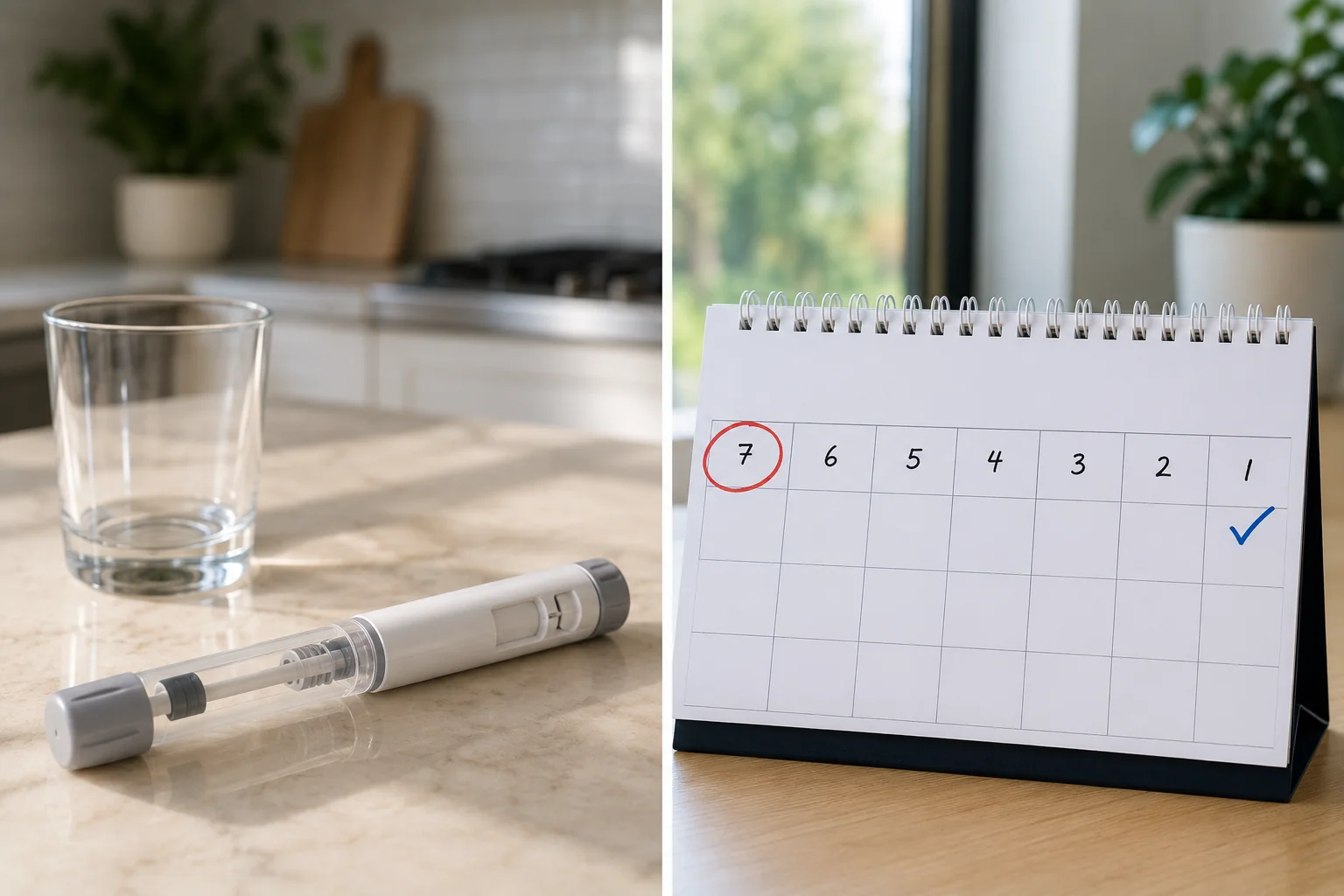
The recommendation Dr. Israel gives our endoscopy patients is to stop the GLP-1 medication at least one week (7 days) before the procedure. This window allows the medication to clear from your system enough that gastric emptying returns toward normal.
For weekly-dosed injectables (Ozempic, Wegovy, Mounjaro, Zepbound, Trulicity), holding the next scheduled dose so that 7 days have passed since the last injection is the practical way to achieve this. For daily oral semaglutide (Rybelsus), stopping 7 days before the procedure achieves the same window. For daily injectables (Saxenda, Victoza), the same 7-day hold applies.
Some practices and societies are moving toward shorter holds (2 to 3 days) when combined with extended liquid-only diet protocols before the procedure. The exact protocol is evolving as more data accumulates. The conservative 1-week hold remains our standard recommendation pending additional research.
What Diabetic Patients Should Do
If you take a GLP-1 medication for type 2 diabetes (not just weight management), do not simply stop the medication without coordinating with your prescribing physician. Stopping the medication can cause your blood sugar to rise during the hold period, which itself creates problems. The right sequence is:
- Notify our office about the GLP-1 medication when you schedule the procedure.
- Contact your prescribing physician (endocrinologist or primary care) about the planned 1-week hold.
- Your physician may bridge with a different short-acting medication, adjust your other diabetic medications, or recommend additional blood sugar monitoring during the hold.
- Confirm the plan with both your endoscopist and your prescribing physician before the day of the procedure.
For weight-management-only use (no diabetes), the 1-week hold is generally straightforward and does not require physician bridging.
What Else to Tell Our Office Before Your Procedure
Beyond GLP-1 medications, several other factors influence sedation safety. Tell our office about:
- All current prescription medications (including doses and times)
- Over-the-counter supplements and herbal products
- Recent changes in any medication
- Allergies, especially to anesthesia agents
- Diabetes, kidney disease, liver disease, sleep apnea, or other major medical conditions
- Pregnancy or possibility of pregnancy
- Prior reactions to sedation
- Recent illness (cold, flu, COVID-19) within the last 2 weeks
The pre-procedure phone call is the time to mention all of these. Our anesthesiologist reviews your full medication and medical list before sedation begins.
If You Forgot to Stop the Medication
If you arrive for your procedure and realize you took your GLP-1 medication within the past week, tell our office immediately, before you receive sedation. The options at that point:
- Reschedule the procedure to a later date that allows the full 1-week hold to clear
- Use rescue protocols (extended liquid-only diet, longer fasting, gastric ultrasound to verify empty stomach in some facilities)
- Use modified anesthesia techniques (rapid sequence intubation in higher-risk cases, in a hospital setting)
The decision is made by your endoscopist and the anesthesiologist together, based on which medication you took, when you took it, what your other medical conditions are, and what the risk-benefit calculation looks like. Most cases simply reschedule.
Why Your Endoscopist Is Asking About These Medications Now
Five years ago, the GLP-1 medication question was rarely on a pre-procedure intake form. Today, with millions of patients on Ozempic, Wegovy, Mounjaro, Zepbound, and similar medications, it is a routine part of every endoscopy and colonoscopy intake. The risk is real but manageable with appropriate planning.
At Gastroenterology and Nutrition P.C., the pre-procedure phone call includes specific questions about GLP-1 use. Our team will tell you exactly when to stop the medication, coordinate with your prescribing physician if needed, and confirm the plan before your procedure date.
Why Forest Hills Patients Choose Our Practice
Gastroenterology and Nutrition P.C. is an AAAASF-certified facility at 108-16 72nd Avenue, 2nd Floor, Forest Hills, Queens NY 11375. Our endoscopy team includes Dr. Samuel Davidoff (Founder, board-certified GI and hepatologist with 18+ years of experience) and Dr. Yuriy Israel (board-certified GI and internal medicine, 15+ years of experience). All sedation is administered by dedicated anesthesiologists. We perform over 2,500 endoscopic procedures per year on-site.
Our patients come from Forest Hills, Rego Park, Kew Gardens, Elmhurst, Jackson Heights, and across Queens. We offer Sunday hours, accept most commercial insurances, Medicare, and various Medicaids. Our team speaks English, Russian, and Spanish.
Schedule an Endoscopy Consultation
Or call (718) 261-0900
Frequently Asked Questions
How long should I stop Ozempic before an endoscopy or colonoscopy?
Per Dr. Israel and current ASA guidance: stop at least 1 week (7 days) before the procedure. For weekly injectables, holding the next scheduled dose so that 7 days have passed since the last injection is the practical approach.
Does this apply to colonoscopy too, or just upper endoscopy?
Both. Any procedure that uses sedation carries the aspiration risk that delayed gastric emptying creates. The 1-week hold applies to upper endoscopy, colonoscopy, combined upper-and-lower procedures, and capsule endoscopy planning.
I take Ozempic for diabetes, not weight loss. Can I still stop it for a week?
Discuss with your prescribing physician (endocrinologist or primary care) before stopping. Your physician may bridge with a short-acting medication, adjust other diabetic medications, or recommend extra blood sugar monitoring during the hold. Do not stop diabetic medications without coordination.
What if I cannot stop my GLP-1 medication for medical reasons?
Your endoscopist and anesthesiologist can use modified protocols, including extended liquid-only diet for a longer pre-procedure window, gastric ultrasound to verify an empty stomach, or modified sedation techniques in a hospital setting. The decision is case-by-case.
Does this apply to other diabetes medications like metformin or insulin?
No, the 1-week hold is specific to GLP-1 receptor agonists because of their effect on gastric emptying. Metformin, insulin, and most other diabetes medications follow different pre-procedure rules and are usually managed with day-of-procedure dose adjustments rather than prolonged holds. Your physician will provide specific guidance.
What happens if I forget and take my Ozempic the day before my procedure?
Tell our office before you receive any sedation. The most likely outcome is rescheduling the procedure for a later date that allows the full hold to clear. Do not try to “push through” the procedure without disclosing the medication.
This information is provided for educational purposes and is not a substitute for professional medical advice, diagnosis, or treatment. Please schedule a consultation with our team to discuss your individual needs.