

Patient Education · Forest Hills, Queens
How Long Does an Upper Endoscopy Take, From Start to Finish?
The upper endoscopy itself takes about five to seven minutes. Plan on roughly an hour to an hour and a half at the office from the time you walk in, which covers your paperwork, the IV, the procedure, and waking up from the sedation. You'll be groggy for the first 15 to 20 minutes and feel close to yourself after that, but because you were sedated, someone else has to drive you home and the rest of your day should stay light.
(718) 261-0900Dr. Yuriy Israel of Gastroenterology & Nutrition, P.C. puts the timing plainly: "The procedure itself takes anywhere between five to seven minutes. However, the entire process may take about an hour to an hour and a half, including putting in the IV, performing the procedure, and the recovery period after anesthesia."
Why the Visit Runs an Hour When the Scope Takes Minutes
Almost none of your appointment is the camera. Here is where the time actually goes at an upper endoscopy at our Forest Hills office:
- Arrival and paperwork. Come in 15 minutes before your appointment time to fill out the forms.
- Getting you ready. A nurse checks your vitals and places the IV, and the anesthesiologist reviews your history and medications with you.
- The procedure, five to seven minutes. You're asleep. A Bite Block holds your mouth open and protects your teeth while the scope passes through your esophagus, stomach, and the first part of your small intestine.
- Waking up, about 20 to 30 minutes. You rest in recovery while the propofol wears off and the staff keep an eye on you.
- Discharge. Your gastroenterologist goes over what was seen, and your ride takes you home.
The scope is the short part. The hour is the sedation, and that's true anywhere the procedure is done properly with an anesthesiologist in the room.
What the Rest of the Day Actually Feels Like
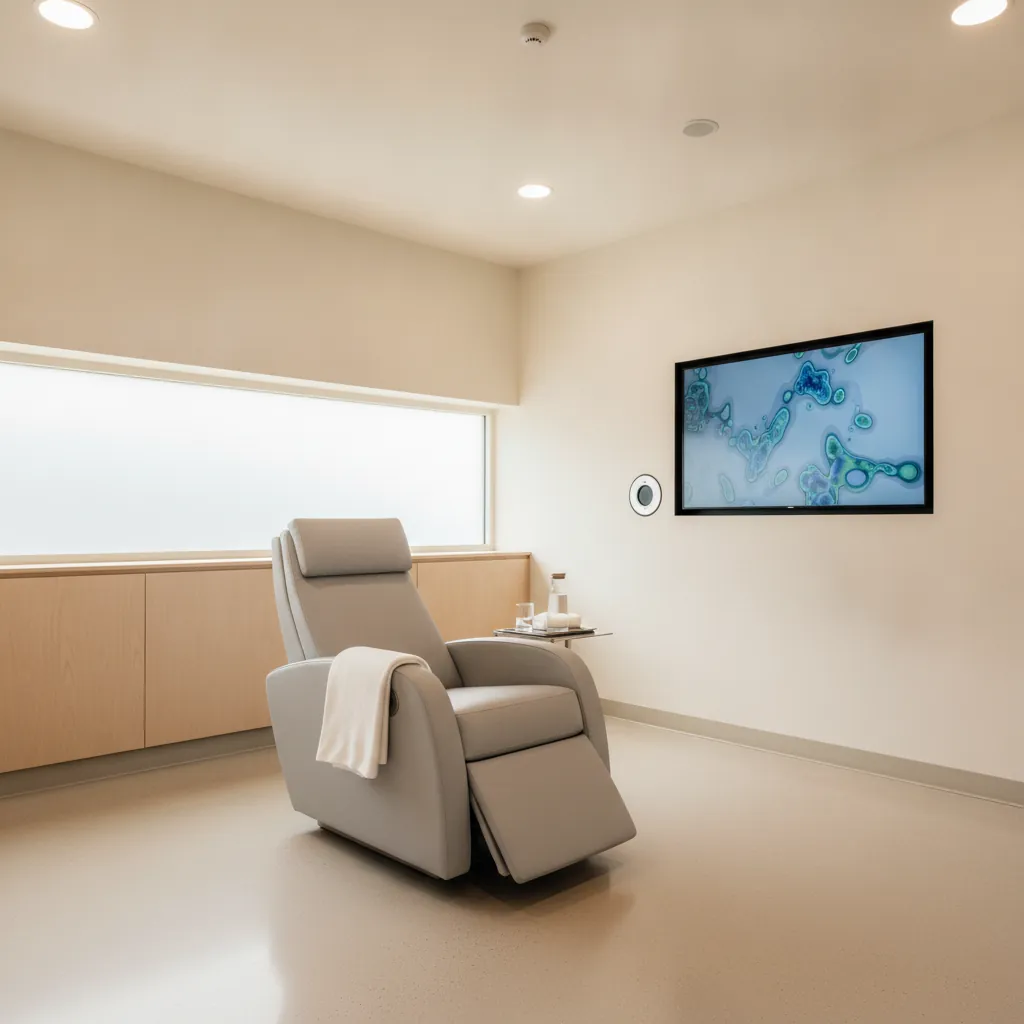
Physically, you bounce back fast. "Immediately after the procedure, you may feel a little groggy," Dr. Israel says, "but once the anesthesia wears off after 15 to 20 minutes, you will feel like your normal self."
The sedation is what sets the limits, and those hold whether or not you feel sharp. Propofol is deep sedation, so for the remainder of the day:
- You can't drive. Arrange a ride before you come in. Every endoscopy center requires it, and your procedure gets postponed if you show up planning to drive yourself home.
- Skip anything that needs sharp judgment. No signing contracts, no operating machinery, and no big decisions until the next morning, even if you feel fine.
- Keep the day light. Most people take the day off and are back to a normal routine the following morning. If you want a picture of the next 24 hours, here is how the next day tends to go.
- No alcohol for 24 hours.
Mild bloating or a slightly scratchy throat for a day is common and settles on its own. Serious complications after a diagnostic upper endoscopy are uncommon, though no procedure is risk-free. Severe or worsening abdominal pain, a fever, trouble swallowing, vomiting blood, or black tarry stools are not part of a normal recovery, and they're a reason to call the office at 718-261-0900 right away.
When You Can Eat Again
Sooner than most people expect. As Dr. Israel describes it, "As soon as you wake up and feel up to it, you can eat whatever you want. The only recommendation is to avoid alcohol for 24 hours after the procedure."
There's no special post-endoscopy diet and no waiting period for a numb throat to wear off, because the sedation is intravenous rather than a throat spray. If your stomach feels a little full of air, start light and give it an hour.
Will You Gag, or Wake Up Sick?
This is the fear that keeps people up the night before, and the answer comes down to which sedation the practice uses. Because you are asleep for it under propofol, the gag reflex is suppressed. "99% of the time, you won't gag because we use an anesthetic called propofol, which puts you in a deep sleep and suppresses the gag reflex," Dr. Israel says. "In places where they use conscious sedation instead of propofol, you may gag, but when we use propofol, you will not." If that's your main worry, here's more on gagging during the procedure.
Nausea is the other common question. Vomiting afterward is not expected after a routine diagnostic upper endoscopy, and Dr. Israel is direct about it: "It's a very benign procedure, and you should not have any gag reflex once you wake up."
What Can Stretch the Day Out, or Cancel It
A few things change the math:
- Biopsies. Tissue samples are taken routinely during an upper endoscopy, since conditions like H. pylori infection, gastritis, and celiac disease can only be confirmed under a microscope. They add very little time on the day, but they do mean some of your answers arrive later, once pathology reports back.
- An empty stomach. You can eat and drink normally until 10 PM the night before, and after that there's no food and nothing to drink either for the 8 to 10 hours before your procedure. A stomach with food in it can mean rescheduling.
- GLP-1 medications. This is the one people miss. Drugs like Ozempic and Mounjaro slow digestion down, so the usual eight hours may not be enough to empty your stomach. Dr. Israel recommends stopping them at least one week before the procedure. Tell the office if you're on one.
Upper Endoscopy at Gastroenterology & Nutrition, P.C. in Forest Hills
Procedures are done on-site at the Forest Hills office, in an AAAASF-accredited facility, under propofol sedation with an anesthesiologist present. Dr. Yuriy Israel, Dr. Samuel Davidoff, and Emanuel Yaakobov, NP, care for patients in English, Russian, and Spanish. Consultations are usually available the same week you call, endoscopies and colonoscopies are offered on Sundays, and there's street parking plus a garage one block away.
"I recently underwent an endoscopy, and I was impressed by the professionalism and care provided by the medical team."
Verified Google review
"Everything went well and recovery was quick."
Verified Google review
The practice accepts the majority of commercial insurances, Medicare, and the various types of Medicaid. To check your plan or book, call 718-261-0900 or request an appointment with Dr. Yuriy Israel and the team.
Disclaimer: This information is provided for educational purposes and is not a substitute for professional medical advice, diagnosis, or treatment. Please schedule a consultation with our team to discuss your individual needs.
FAQ
Common Questions
Gastroenterology & Nutrition, P.C. · Forest Hills, Queens
Ready to Schedule Your Appointment?
Same-week consultations. Sunday procedures offered. Most major insurance accepted.