Patient Education · Forest Hills, Queens
Is Fibermaxxing Safe? A Gastroenterologist on the Fiber Trend
Yes, for most people fibermaxxing is safe. The hashtag is new, but the idea behind it is not: a high-fiber diet has been a mainstream medical recommendation for decades, and it is genuinely hard to overdo fiber. The part that trips people up is how they get there. If your diet is currently low in fiber, increase it slowly over several weeks rather than all at once, drink more water as you do, and lean on fruits, vegetables, and soluble fiber. Ramp up too fast and you can end up with real bloating, cramping, and even constipation.
(718) 261-0900Medically reviewed by Dr. Yuriy Israel, MD, Gastroenterology | 10+ Years Experience | Last Updated: August 2026
So the short answer is reassuring, with a few practical caveats that decide whether fibermaxxing feels good or makes you miserable. Here is what a gastroenterologist wants you to know before you try it.
Is the Science Behind Fibermaxxing Actually New?
Not really. Fibermaxxing is a recent social media trend, but the underlying advice to eat plenty of fiber is one of the older and better-established recommendations in medicine. Dr. Israel points out that a high-fiber diet has long been recommended for a range of conditions, including diverticulosis, hemorrhoids, and high cholesterol.
That history matters, because it tells you the goal is sound even if the packaging is trendy. Fiber supports regular, comfortable bowel movements, feeds the beneficial bacteria in your gut, helps carry cholesterol out of the body, and adds bulk that keeps you full. The trend is essentially social media catching up to advice gastroenterologists and dietitians have given for years. What the trend often skips is the how, and the how is where people run into trouble.
Can You Actually Eat Too Much Fiber?
For practical purposes, most people cannot overdo fiber in the sense of hitting a hard ceiling. As Dr. Israel puts it, you cannot really overdo fiber. The problems people blame on eating too much fiber are almost always problems of eating too much fiber too suddenly, and those are avoidable.
Think of it less as a dose you can exceed and more as a change your body needs time to accept. Go there gradually and your system adapts. Sprint there overnight and your gut protests. The rest of this comes down to two simple habits: pace, and water.
Why Ramping Up Too Fast Backfires
If your current diet is low in fiber, the single most important step is to increase it slowly over the course of several weeks. A sudden large jump is the usual cause of severe bloating and cramping, the exact symptoms people mistake for a fiber intolerance.
The reason is your gut microbiome. The bacteria in your colon are what break down much of the fiber you eat, and that fermentation produces gas as a normal byproduct. When you flood your system with far more fiber than it is used to, the microbiome has not yet shifted to handle it, and you feel that mismatch as bloating, gas, and cramping. Give it a few weeks of steady, gradual increases and the balance of bacteria adjusts, the gas settles, and the discomfort fades. The fiber did not become safer. Your gut simply caught up.
Do Not Forget the Water
Here is the caveat that surprises people. Fiber absorbs water, so as you add fiber you also need to add fluids. If you increase fiber without drinking more, the added bulk can actually cause constipation, which is the opposite of what most people are going for.
Picture soluble fiber as a sponge moving through your digestive tract. With enough water, it stays soft, gel-like, and easy to pass. Without it, it can turn firm and sluggish. This is why more fiber and more water go together as a pair, not one without the other. If you are increasing your fiber and things feel slower rather than smoother, water is the first thing to check.
Where to Get Your Fiber
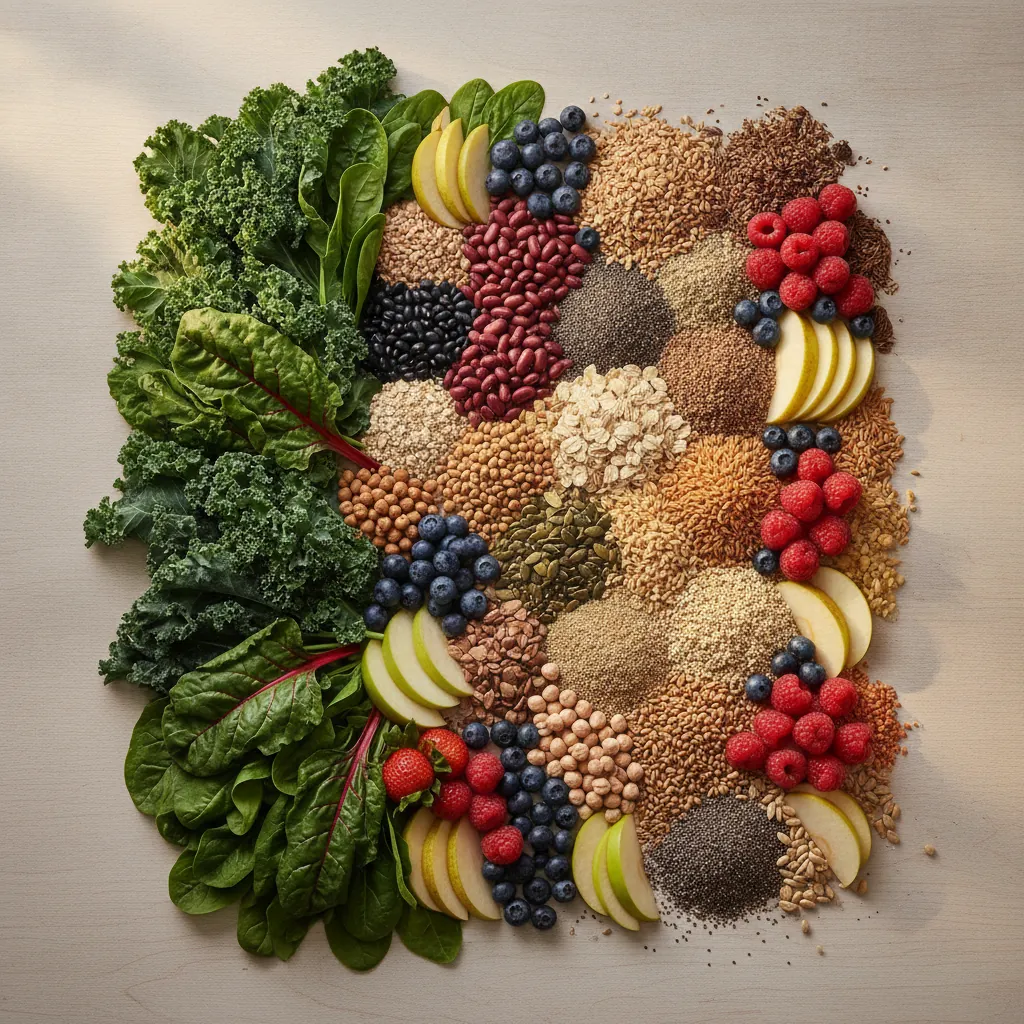
You have two good sources, and a combination of the two works well. The first is food. Dr. Israel recommends fiber from fruits and vegetables, and notes that some are far higher in fiber than others, so variety helps you get there. Whole fruits with their skins, vegetables, beans and lentils, and whole grains are all dense sources, and getting fiber from food also brings along vitamins and water.
The second source is an over-the-counter fiber supplement. If you go this route, the type matters. Dr. Israel notes that soluble fiber is generally better tolerated than insoluble fiber for this purpose. Soluble fiber dissolves in water and forms that soft gel, which tends to be gentler on the gut and helpful for regularity and cholesterol. Many people do best with a mix: mostly food, with a supplement to close the gap on days that fall short. Whichever you choose, the same two rules apply. Build up gradually, and drink more water.
Who Benefits Most From More Fiber
Because fiber does several jobs at once, a number of common conditions tend to improve with a higher-fiber diet. Dr. Israel specifically names diverticulosis, hemorrhoids, and high cholesterol among the reasons the recommendation has stood for so long. Softer, bulkier, easier-to-pass stools take strain off the rectal veins, which is why fiber is a first-line piece of hemorrhoid care. Soluble fiber can help lower cholesterol by binding it in the digestive tract. And adequate fiber supports the steady, comfortable digestion that keeps many everyday GI complaints in check, which also matters for long-term colon health and colorectal cancer prevention.
If you have an ongoing digestive condition, it is worth checking with a gastroenterologist before making a large dietary change, since a few conditions call for a more tailored approach to fiber rather than simply more of it.
Gut Health and Nutrition Care at Gastroenterology & Nutrition, P.C.
Gastroenterology & Nutrition, P.C. is a gastroenterology practice in Forest Hills, Queens, where nutrition and digestive health are treated as part of the same picture. Dr. Yuriy Israel is dual board-certified in gastroenterology and internal medicine and has cared for patients here since 2016, seeing patients alongside Dr. Samuel Davidoff and Emanuel Yaakobov, NP.
"I was hoping for advice on gut health and nutrition."
Verified Google review
The team works in English, Russian, and Spanish, and the practice accepts the majority of commercial insurances, Medicare, and the various types of Medicaid. If you are dealing with constipation, bloating, hemorrhoids, or you simply want a realistic plan for adding fiber to your diet, call 718-261-0900 or book a consultation.
Disclaimer: This information is provided for educational purposes and is not a substitute for professional medical advice, diagnosis, or treatment. Please schedule a consultation with our team to discuss your individual needs.
FAQ
Frequently Asked Questions
Gastroenterology & Nutrition, P.C. · Forest Hills, Queens
Ready to Schedule Your Appointment?
Same-week consultations. Sunday procedures offered. Most major insurance accepted.